

Couldn't load pickup availability
* All power ratings are figured using an electronic high pass crossover with a minimum crossover point of 60Hz at 24dB/Octave, 70Hz at 18dB/Octave, or 80Hz at 12dB/Octave.
* All power ratings are figured using an electronic high pass crossover with a minimum crossover point of 300Hz at 24dB/Octave, 325Hz at 18dB/Octave, or 350Hz at 12dB/Octave.
* All power ratings are figured using an electronic high pass crossover with a minimum crossover point of 3kHz at 24dB/Octave, 3.5kHz at 18dB/Octave, or 4kHz at 12dB/Octave.
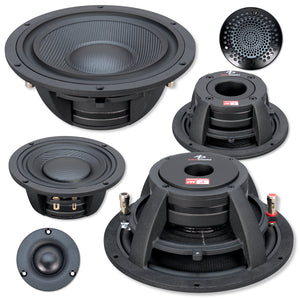
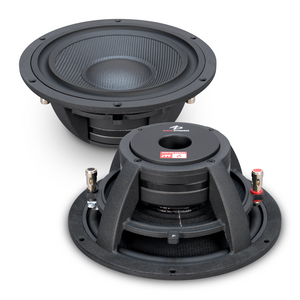
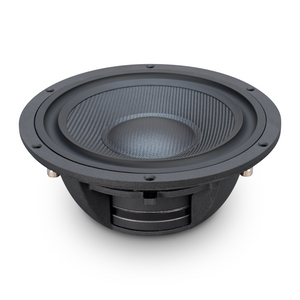
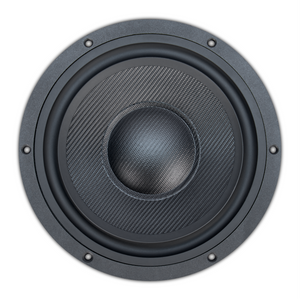
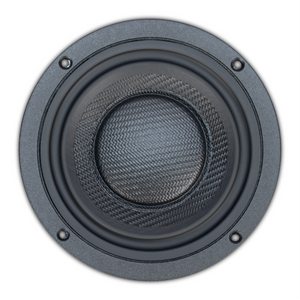
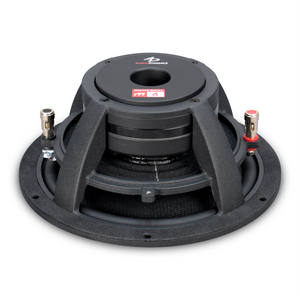
The Master Series M6 mid-woofer is a high stroke, low distortion high output mid-woofer. This speaker features high stroke, low distortion, wide bandwidth, and high power handling. It features a 51mm / 2" voice coil diameter for high power handling and motor force.
The M6 mid-woofer features a split-gap design which provides ±8.7mm of linear excursion, allowing for displacement equal to many 8 inch woofers. The high linear stroke features a flat BL curve for exceptional dynamics and impact.
The M6 has multiple copper shorting rings within its magnetic structure. These features result in exceptionally low inductance at all operational frequencies and across stroke. This further extends bandwidth as well as reduces motional intermodulation distortion for a much more open and natural midrange.
The M6 uses a thermo-fused woven, strand-oriented-chain hardened polyolefin cone. This cone features very high strength due to the strand orientation of the polyolefin monomer chains, and exceptional internal damping from the polyolefin itself. The thermal fusing ensures an air-tight surface without degrading the woven feature and strand orientation. The result is a cone with over 600 MPa of tensile strength, vastly superior internal damping as compared to carbon and glass fibers, and a density of just 0.9 g/cm3 , approximately 40% that of carbon fiber.
The M6 basket is also extremely open and holds the motor structure at the rear, so that basket-based reflections back up to the cone are minimized. Use of a shallow split gap motor structure and custom tooled basket, surround, cone, and spider result in a very shallow mounting depth so the mid-woofer can fit into shallow locations, enabling creative positioning for best acoustical performance.
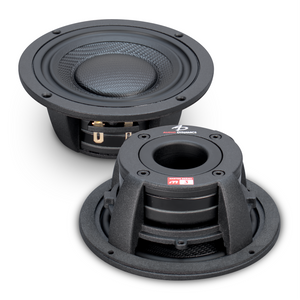
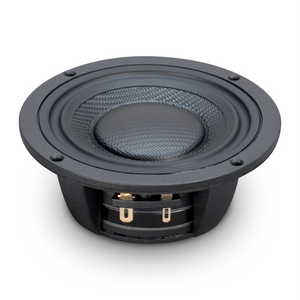
The Master Series M3 midrange is a high stroke, low distortion wideband midrange. This midrange has high stroke, very wide bandwidth, and high power handling. It features a 38mm / 1.5" voice coil diameter for high power handling and motor force.
The M3midrange features a split-gap design which provides ±4.5mm of linear excursion, about double of most 75mm/3 inch midranges. This lowers distortion over the operational range and allows a mid to play at least half an octave lower in frequency, allowing better imaging and sonic cohesion.
The M3 has multiple copper shorting rings within its magnetic structure. These features result in exceptionally low inductance at all operational frequencies and across stroke. This further extends bandwidth as well as reduces motional inter-modulation distortion for a much more open and natural midrange.
The M3 uses a thermo-fused woven, strand-oriented-chain hardened polyolefin cone. This cone features very high strength due to the strand orientation of the polyolefin monomer chains, and exceptional internal damping from the polyolefin itself. The thermal fusing ensures an air-tight surface without degrading the woven feature and strand orientation. The result is a cone with over 600 MPa of tensile strength, vastly superior internal damping as compared to carbon and glass fibers, and a density of just 0.9 g/cm3 , approximately 40% that of carbon fiber.
The M3basket is also extremely open and holds the motor structure at the rear, so that basket-based reflections back up to the cone are minimized. Use of a shallow split gap motor structure and custom tooled basket, surround, cone, and spider result in a very shallow mounting depth so the midrange can be placed as high as possible within a vehicle, to raise the stereo image up near the head of the listener.
The M3 comes with a chemically etched steel grille featuring an anti-resonant hole-pattern with size of opening optimized for dispersion. The grille is mounted to the midrange with a friction-fit gasket ensuring vibration-free operation and eliminating visible screws.
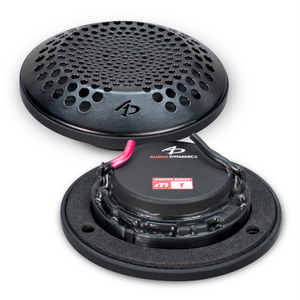
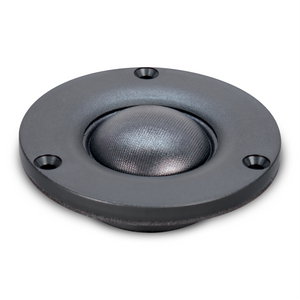
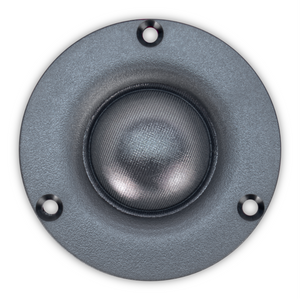
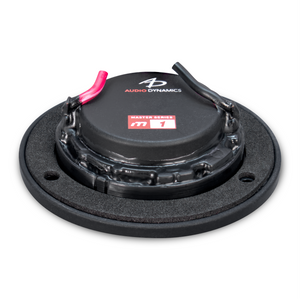
The Master Series M1 tweeter is a high stroke, low distortion multilayer fabric dome 25mm tweeter. This tweeter features exceptionally high stroke to allow lower crossover points without compression.
The M1 tweeter features a split-gap design which provides ±1.6mm of linear excursion, approximately 5 to 6 times that of most other tweeters. The result is a wider operational bandwidth - as low at 1500 Hz - and distortion reduced by up to a factor of 4.
The M1 use a specially developed dome material. The dome's fabric is a lamination of silk, polyester, and cotton and treated with a proprietary compound to unify the layers but allow each to provide their own unique benefits. Silk adds the stretch/pull basic mechanical strength; polyester provides rigidity of shape; cotton provides improved damping.
The M1 does not use a rear chamber to lower its resonance; instead, a larger roll surround provides a lower resonance of the driver. This design allows for higher stroke as well, for full-range output down to 1500 Hz. And by removing the rear chamber, resonances from that chamber are eliminated. The elimination of the rear chamber results in an 11.7mm (15/32") mounting depth for freedom of positioning.
The M1 comes with a chemically etched steel grille featuring an anti-resonant hole-pattern with size of opening optimized for dispersion. The grille is mounted to the main tweeter with a friction-fit gasket ensuring vibration-free operation and eliminating visible screws.
The M6 mid-woofer is a wide bandwidth, high stroke speaker. A low pass crossover should be set no higher than 3500 Hz. The actual value should be selected based upon the paired tweeter, midrange, or full-range speaker.
The bottom end is robust, and can often forego a subsonic filter. The following table summarizes general guidelines about a subsonic filter. As noted above, this is not a hard-and-fast set of limits, and the final installation needs to be considered when setting actual crossover values and gains.
| Power | 6dB/Oct | 12dB/Oct | 18dB/Oct | 24dB/Oct |
| 50W | Not necessary | Not necessary | Not necessary | Not necessary |
| 100W | Not necessary | Not necessary | Not necessary | Not necessary |
| 200W | 100 Hz | 80 Hz | 70 Hz | 60 Hz |
| 400W | 170 Hz | 135 Hz | 110 Hz | 100 Hz |
Note that with lower power applications, these frequencies may be adjusted down; with higher power, you may need to adjust the frequencies up. Again, the actual implementation of the entire system needs to be considered when installing these products. A small sealed chamber behind the midrange can increase mechanical power handling, but may negatively impact thermal power handling.
The M3 midrange is a wideband, high stroke speaker. A low pass filter for blending with a tweeter would be dependent upon the tweeter and location of tweeter and the M3. As the M3 naturally rolls off above 12 kHz, it can often be used as a near-full-range speaker without a low pass filter applied.
The following table summarizes general guidelines for a high pass filter for use with the M3. As noted above, this is not a hard-and-fast set of limits, and the final installation needs to be considered when setting actual crossover values and gains.
| Power | 6dB/Oct | 12dB/Oct | 18dB/Oct | 24dB/Oct |
| 50W | 250 Hz | 225 Hz | 200 Hz | 160 Hz |
| 100W | 400 Hz | 300 Hz | 250 Hz | 225 Hz |
| 200W | 450 Hz | 350 Hz | 325 Hz | 300 Hz |
| 400W | Not Recommended | Not Recommended | 400 Hz | 350 Hz |
Note that with lower power applications, these frequencies may be adjusted down; with higher power, you may need to adjust the frequencies up. Again, the actual implementation of the entire system needs to be considered when installing these products. A small sealed chamber behind the midrange can increase mechanical power handling, but may negatively impact thermal power handling.
The M1 Tweeter is a wideband, high stroke tweeter. This gives it quite a bit of flexibility in operation. The following table summarizes general guidelines. As noted above, this is not a hard-and-fast set of limits, and the final installation needs to be considered when setting actual crossover values and gains.
| Power | 6dB/Oct | 12dB/Oct | 18dB/Oct | 24dB/Oct |
| 50W | 2000 Hz | 1750 Hz | 1500 Hz | 1200 Hz |
| 100W | 2800 Hz | 2200 Hz | 2000 Hz | 1800 Hz |
| 200W | 4500 Hz | 3500 Hz | 2600 Hz | 2350 Hz |
| 400W | Not Recommended | Not Recommended | Not Recommended | 4000 Hz |
Not that with lower power applications, these frequencies may be adjusted down; with higher power, you may need to adjust the frequencies up. Again, the actual implementation of the entire system needs to be considered when installing these products.


| Nominal Impedance | 4 Ohms |
| Nominal SPL | 86 dB @ 1W, 1m (89 dB @ 2.83Vrms, 1m) |
| Resonant Frequency (Fs) | 65 Hz ±10% |
| Total System Q (Qts) | 0.75±15% |
| Equivalent Volume Air (Vas) | 8 liters ±15% |
| Motor Force (BL) | 5.8 N/A ±10% |
| Inductance (Le) | 0.110mH±5% |
| DC Resistance (DCR) | 3.8 Ohms ±5% |
| Moving Mass (Mms) | 21 grams ±10% |
| Electrical Q (Qes) | 0.95±10% |
| Mechanical Q (Qms) | 3.5±15% |
| Diaphragm Surface Area (Sd) | 133 cm²±2% |
| Linear Excursion (Xmax) | 8.7mm one way ±5% |
| Nominal Impedance | 4 Ohms |
| Nominal SPL | 84 dB @ 1W, 1m (87 dB @ 2.83Vrms, 1m) |
| Resonant Frequency (Fs) | 149 Hz ±10% |
| Total System Q (Qts) | 1.3±15% |
| Equivalent Volume Air (Vas) | 0.5 liters ±15% |
| Motor Force (BL) | 2.7 N/A ±10% |
| Inductance at 1 kHz (Le) | 0.08 mH ±5% |
| DC Resistance (DCR) | 3.3 Ohms ±5% |
| Moving Mass (Mms) | 4.7 grams ±10% |
| Electrical Q (Qes) | 1.6±10% |
| Mechanical Q (Qms) | 6.3±15% |
| Diaphragm Surface Area (Sd) | 39 cm²±2% |
| Linear Excursion (Xmax) | 4.5mm one way ±5% |
| Impedance | 4 Ohms |
| Nominal SPL | 89 dB @ 1W, 1m (92 dB @ 2.83Vrms, 1m) |
| Resonant Frequency | 1500 Hz ±10% |
| THD @ 100 dB, 4th order high pass @ 1500 Hz | Less than 1%, 1 meter |
| Max power handling | 400W, 4th order high pass @ 4000 Hz |
You may return most new, unopened items within 30 days of delivery for a full refund. We'll also pay the return shipping costs if the return is a result of our error (you received an incorrect or defective item, etc.).
You should expect to receive your refund within four weeks of giving your package to the return shipper, however, in many cases you will receive a refund more quickly. This time period includes the transit time for us to receive your return from the shipper (5 to 10 business days), the time it takes us to process your return once we receive it (3 to 5 business days), and the time it takes your bank to process our refund request (5 to 10 business days).
If you need to return an item, simply login to your account, view the order using the "Complete Orders" link under the My Account menu and click the Return Item(s) button. We'll notify you via e-mail of your refund once we've received and processed the returned item.
We can ship to virtually any address in the world. Note that there are restrictions on some products, and some products cannot be shipped to international destinations.
When you place an order, we will estimate shipping and delivery dates for you based on the availability of your items and the shipping options you choose. Depending on the shipping provider you choose, shipping date estimates may appear on the shipping quotes page.
Please also note that the shipping rates for many items we sell are weight-based. The weight of any such item can be found on its detail page. To reflect the policies of the shipping companies we use, all weights will be rounded up to the next full pound.


